The short answer, before the detail
Sardinia does not have one coast: it has at least five, and they differ from each other more than you would expect. Travelling with small children, head for the south-east, between Villasimius and Costa Rei, where the sand is very fine and the water stays shallow a long way out. Want clear water and granite coves, go to Gallura. Want landscapes that look like another continent, and the wind does not put you off, the Costa Verde. Willing to take a boat or walk, the Gulf of Orosei has the finest coves on the island. And if you want the sea with a real town around it, Alghero.
The south-east: Villasimius, Costa Rei and Capo Carbonara
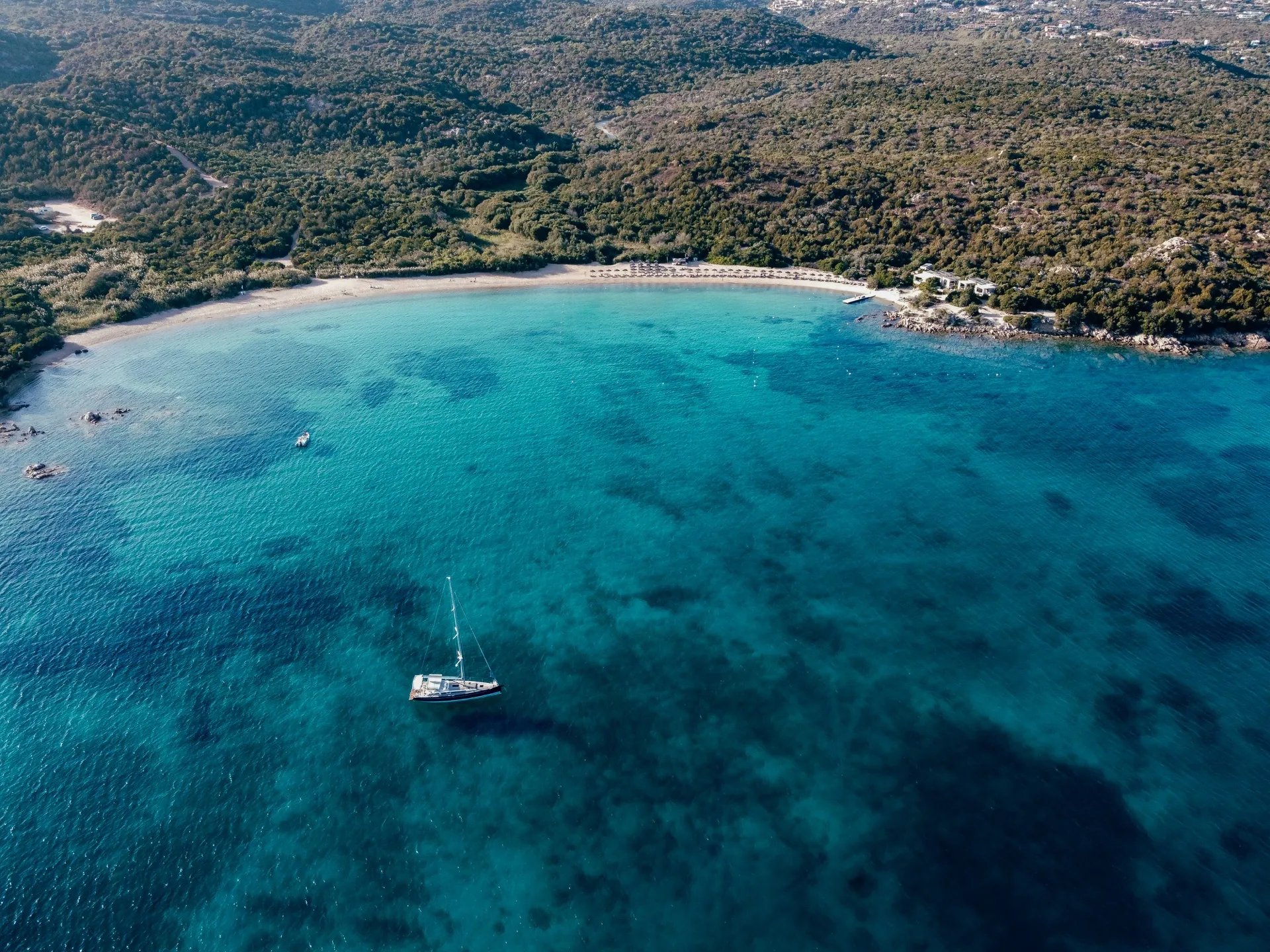
This is the area we most often suggest to families coming for the first time. The sand is pale and fine, the seabed shelves gently, and the water has that colour which in photographs looks retouched. Porto Giunco, with the salt lagoon and its flamingos behind it, is the image everyone has in mind when they think of Sardinia; Simius is longer and more convenient, minutes from town; Punta Molentis is a cove set among the rocks, so photogenic that access is capped in high season.
The most practical advantage of this coast is that it is sheltered from the mistral. When the north-westerly makes half the island unusable, the sea here often stays flat. The other advantage is distance: it is a little over an hour from Cagliari, so it works for anyone landing at Elmas who does not want to drive all day. If the area appeals, our page on Villasimius goes into detail.
Cagliari and its shoreline
The Poetto is a rare thing: eight kilometres of beach inside a city, with a bus route to it, kiosks open late and the flamingos of the Molentargius lagoon behind. It is not the postcard beach, but it is the most convenient on the island and in summer it stays alive well into the night.
Heading east the shoreline changes quickly: Margine Rosso, then Mari Pintau with its pebbles and clear water, then Geremeas and Torre delle Stelle. Twenty minutes by car takes you from a city beach to far quieter coves. That is why Cagliari and its coast work well for anyone who wants sea and city in the same holiday.
The Costa Verde: Torre dei Corsari, Scivu, Piscinas
Here the landscape changes register. Golden dunes rise tens of metres, there are centuries-old junipers, and behind them lies the old mining country with the abandoned villages of Ingurtosu and Montevecchio. The beaches are vast and almost never crowded, even in August, because the tourist infrastructure of the other coasts simply is not here.
What the photographs do not tell you, though, is that the mistral really blows here, the aspect is due west and facilities are sparse. It is the right coast for anyone after sunsets over open sea, space and silence, and for kitesurfers and wave surfers. It is the wrong coast for anyone who wants a sunbed in a row and a bar ten metres away. Our page on Torre dei Corsari explains how the area works.
Gallura and the north-east
This is the Sardinia best known abroad: pink granite, maquis, small coves and water that shifts from green to blue within a few metres. The Costa Smeralda has the most celebrated beaches, from Principe to Liscia Ruja, but the whole surrounding area holds its own without Porto Cervo prices: Baja Sardinia, Cannigione and the gulf towards Palau, and further south Golfo Aranci and Pittulongu.
This is also where boats leave for the Maddalena archipelago, which deserves a full day: Budelli, Spargi, Santa Maria and their shallow waters. You go on an organised boat or take the ferry to La Maddalena, and in high season it is worth booking a few days ahead.
The Gulf of Orosei: the coves you reach by boat
If we had to name the most spectacular beaches on the island, we would name these. Cala Luna, Cala Mariolu, Cala Sisine, Cala Goloritzè, Cala Biriala: white cliffs dropping straight down, polished pebbles, turquoise water. The catch is that almost none of them can be reached by car. You take a boat from the little harbour at Cala Gonone or from Santa Maria Navarrese, or you walk, sometimes for hours and on demanding paths.
Which means they need planning: pick a calm day, book the trip, bring water and lunch because there is nothing there. Some coves have a daily visitor cap and an access charge. This is the part of Sardinia that rewards preparation most, and disappoints improvisation. The area is Dorgali and Cala Gonone.
The north-west: Alghero, Stintino and the Coral Riviera
Alghero is the one place on the island where you get a walled Catalan town and, minutes away, beaches like Le Bombarde, Lazzaretto and Maria Pia with its pine wood. It is the best answer for anyone who cannot face a holiday made only of beach and car.
Further north lies La Pelosa, at Stintino, perhaps the most photographed beach in Sardinia: white sand, water that stays shallow for tens of metres, the Aragonese tower in front. Precisely because it is fragile and famous, in summer entry is charged, capped and bookable in advance. It is not a beach you happen upon.
The beaches with capped entry in 2026
This is what catches most visitors out. Several of the island's most fragile beaches now have a daily cap on numbers, an access contribution and compulsory booking. These are the 2026 figures: check them before you travel, because they change every year.
| Beach | Municipality | Places per day | Contribution | Season |
|---|---|---|---|---|
| La Pelosa | Stintino | 1,500 | €3.50 (free under 12) | 15 May - 15 October |
| Tuerredda | Teulada | 1,100 | €3 | 2 June - 15 October |
| Punta Molentis | Villasimius | 150 by land | €10 | 6 June - 31 October |
| Cala Brandinchi | San Teodoro | 1,447 | €2 (€1 reduced) | 1 June - 30 September |
| Lu Impostu | San Teodoro | 3,352 | €2 (€1 reduced) | 1 June - 30 September |
| Cala Goloritzè | Baunei | 250 | €7 | summer |
| Cala Luna, Mariolu, Biriola, dei Gabbiani, Su Sirboni | Baunei | capped | access contribution | summer |
| Cala Coticcio and Cala Brigantina | Caprera, La Maddalena | 60 | €3 plus compulsory guide | summer |
| Rena Bianca | Santa Teresa Gallura | capped | €3.50 | all year |
Bookings are made online, each on its own channel: the Baunei beaches go through the Heart of Sardinia app, Tuerredda and La Pelosa have dedicated sites, Punta Molentis is booked on the Villasimius council portal, San Teodoro has its own app. For Tuerredda the next day's places are released every morning at eight and go quickly. At Cala Coticcio and Cala Brigantina, on the island of Caprera, you cannot go in on your own: an authorised environmental guide is required.
The wind rule, worth more than any ranking
If one thing separates people who know the island from first-time visitors, it is this: you choose the beach in the morning, by looking at the wind. The mistral blows from the north-west even at the height of summer. When it is strong, the west coast and the Costa Verde become waves and sand in your eyes, while the south-east and the gulf of Olbia stay calm. With a sirocco it is the other way round.
That is why it pays to choose a base from which several different coasts are within an hour's drive, rather than betting everything on one beach. And it is why a host who offers you two or three alternatives depending on the forecast can save your holiday.
The rules to know before you arrive
You take nothing home. Sand, pebbles and shells are protected by regional law and removing them is illegal: checks at the airport and the port are real and the fines are heavy. This is not a formality and it is not folklore.
Then there is limited access. The most fragile beaches operate visitor caps, online booking or an entry contribution in high season, and the rules change from one season to the next: worth checking a few days ahead rather than finding out in the car park. The same goes for parking, which in summer is charged almost everywhere and fills up early in the morning.
Finally two practical things: many beaches have no natural shade and the wind makes parasols hard work, so a low beach tent is often the most useful purchase of the trip. And dogs are not allowed everywhere: there are designated beaches, but you need to find them before you travel.
Choosing a base, in practice
The advice we give most often is not to move every two days. Distances in Sardinia look short on the map and are not: the roads are single carriageway and in summer they are slow. Better to pick one area, take a house there and make day trips, than to chase the whole island in a week.
If you are not sure where to start, look through our destinations: for each one we describe the nearby beaches, how to get there and what to expect. And if you want a straight opinion on the dates you have in mind, write to us: we do reply.
Where the figures on this page come from
This guide was last updated in August 2026. Fares, timetables and beach access rules change every season, so rather than asking you to take our word for it, here is where we checked: the Tuerredda booking service, the one for La Pelosa at Stintino, the San Teodoro beaches portal and Villasimius council for the 2026 caps and access contributions. If you find a figure that no longer holds, tell us and we will correct it: we would rather have a page that is right than one that looks complete.